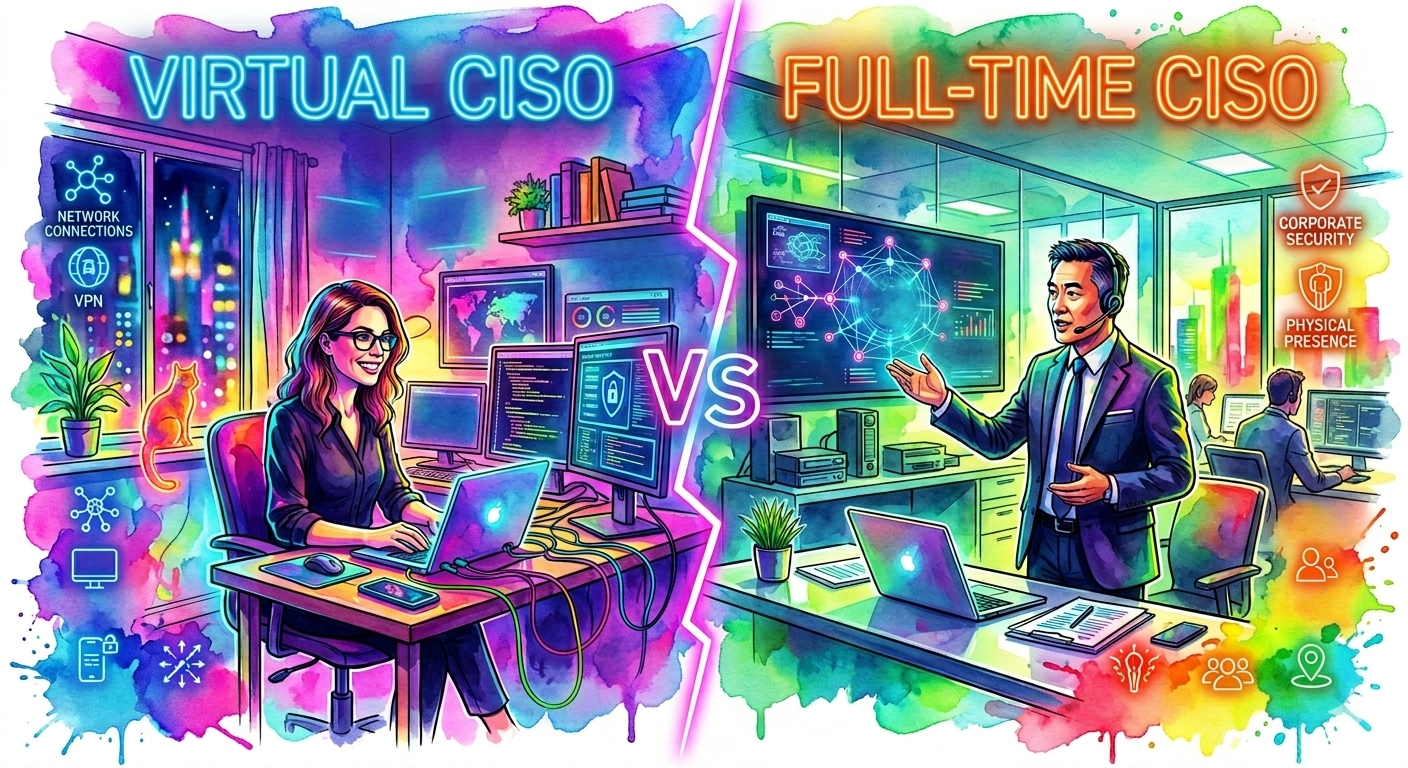
As cyber threats escalate and regulatory scrutiny intensifies, companies across India, Southeast Asia, and the Gulf are confronting a critical decision:
Do we hire a full-time CISO — or engage a Virtual CISO (vCISO)?
This is not merely a cost question.
It is a governance, maturity, and strategic alignment decision.
According to the 2023 IBM Cost of a Data Breach Report, the global average cost of a data breach reached USD 4.45 million, the highest ever recorded at the time. Organizations with mature incident response testing and governance programs reduced breach costs significantly compared to those without.
Leadership maturity directly impacts financial outcome.
The Expanding Role of the CISO
The modern Chief Information Security Officer is no longer a technical firewall administrator.
Today’s CISO is responsible for:
- Enterprise cyber risk management
- Regulatory compliance oversight
- Board reporting
- Incident response governance
- Third-party risk management
- Cloud security strategy
- Business continuity coordination
In regulated environments, the CISO also plays a key role in:
- Audit defense
- Investor due diligence
- M&A cybersecurity assessments
This expanded mandate explains why CISO demand continues to rise globally.
However, hiring one is not always straightforward.
The CISO Talent Gap: A Global Constraint
The global cybersecurity workforce shortage remains significant.
The (ISC)² Cybersecurity Workforce Study reported millions of unfilled cybersecurity roles worldwide in recent years. Many high-growth markets — including South Asia and Southeast Asia — experience disproportionate shortages of experienced governance-focused leaders.
This creates three realities:
- Experienced CISOs are expensive.
- Hiring cycles are long.
- Retention is difficult.
For many SMEs and scaling enterprises, a full-time CISO may exceed operational budget or organizational complexity.
Understanding the Full-Time CISO Model
Advantages
A full-time CISO provides:
- Deep organizational immersion
- Continuous executive presence
- Direct accountability
- Embedded culture transformation
- Long-term strategic continuity
In large enterprises — especially in banking, telecommunications, energy, or critical infrastructure — this is often non-negotiable.
Limitations
However:
- Total compensation packages can be substantial.
- Smaller organizations may underutilize the role.
- Reporting structures sometimes compromise independence (e.g., reporting into IT instead of risk or CEO).
- Recruiting experienced leaders in emerging markets is challenging.
In early-stage or mid-sized firms, governance needs may not justify enterprise-scale overhead.
What Is a Virtual CISO?
A Virtual CISO (vCISO) provides strategic cybersecurity leadership on a fractional or contractual basis.
Unlike outsourced IT security services, a vCISO focuses on:
- Governance frameworks
- Risk quantification
- Board reporting
- Regulatory alignment
- Policy development
- Incident response readiness
- Vendor oversight
The vCISO operates at a strategic level — not as a helpdesk or technical administrator.
Why the vCISO Model Is Growing
The rise of SaaS, cloud-native startups, and cross-border digital businesses has changed the economics of leadership.
According to Gartner projections in recent years, cybersecurity spending continues to grow globally despite macroeconomic slowdowns — reflecting board-level prioritization.
However, not all organizations need 40+ hours per week of CISO leadership.
A vCISO allows:
- Cost control
- Governance acceleration
- Independent oversight
- Scalability
- Regulatory readiness
This model is particularly attractive for:
- Startups preparing for Series A/B funding
- SMEs entering regulated markets
- Companies expanding internationally
- Organizations recovering from a breach
Cost Considerations: Strategic vs Operational Spend
Let’s frame this clearly.
A full-time CISO compensation package may include:
- Base salary
- Performance bonus
- Equity
- Benefits
- Support staff
In contrast, a vCISO operates on:
- Monthly retainer
- Defined scope
- Governance deliverables
- Board reporting cycles
For growth-stage companies, the question becomes:
Are we paying for continuous operational leadership — or structured governance maturity?
The answer depends on organizational complexity.
Impact on Breach Outcomes
The IBM Cost of a Data Breach Report consistently shows that organizations with:
- Incident response teams
- Regular testing
- Formalized governance programs
Experience significantly lower breach costs compared to those without tested response plans.
Leadership maturity influences:
- Detection speed
- Containment time
- Communication quality
- Regulatory response
- Legal exposure
Whether delivered by a full-time CISO or vCISO, structured oversight materially reduces impact.
Decision Framework: When to Hire Full-Time
A full-time CISO is appropriate when:
- The organization exceeds several hundred employees.
- It operates in highly regulated sectors.
- It manages critical infrastructure.
- It handles large volumes of sensitive data.
- Cyber risk exposure is continuously high.
- M&A activity is frequent.
- Security operations teams are large.
In these environments, daily executive engagement is necessary.
Decision Framework: When a vCISO Is Strategic
A vCISO is often ideal when:
- The organization is scaling rapidly.
- Board-level reporting is required but not daily operational leadership.
- Compliance maturity needs development.
- Security teams exist but lack strategic direction.
- Budgets require flexibility.
- The company operates across multiple jurisdictions but lacks centralized oversight.
In many emerging digital markets, this model bridges a crucial maturity gap.
Governance Independence: A Critical Factor
One overlooked factor is independence.
In many companies, the CISO reports to the CTO, CIO or IT Director.
This structure can create conflicts between:
- Operational delivery pressures
- Risk transparency
- Budget prioritization
A vCISO model often reports directly to the CEO or Board — reinforcing independence and objectivity.
From a governance perspective, this can be highly valuable.
The Hybrid Model: A Practical Evolution
Increasingly, organizations adopt a hybrid structure:
- Internal security manager or engineering lead
- External vCISO providing governance oversight
- Third-party technical partners
This model balances:
- Technical continuity
- Strategic maturity
- Cost optimization
For mid-market enterprises in India, Southeast Asia, and the Gulf region, this approach can accelerate governance alignment without overstretching budgets.
Common Misconceptions
Myth 1: A vCISO is just a consultant.
Reality: A strategic vCISO embeds into governance cycles and executive reporting.
Myth 2: Only large enterprises need a CISO.
Reality: Regulatory reporting and investor scrutiny increasingly affect mid-sized firms.
Myth 3: Tools replace leadership.
Reality: Technology without governance increases complexity, not resilience.
Investor & Due Diligence Implications
Venture capital and private equity firms increasingly assess:
- Security maturity
- Incident history
- Regulatory exposure
- Governance structure
Companies without formal security leadership — even fractional — may face valuation pressure.
Cyber due diligence is now standard in cross-border deals.
Strategic Recommendation
The right question is not:
“Which is cheaper?”
The right question is:
“What level of governance maturity does our growth trajectory require?”
For early-stage or scaling enterprises:
→ A structured vCISO engagement often delivers immediate maturity uplift.
For mature, regulated enterprises:
→ A full-time CISO is essential.
The decision should align with:
- Risk exposure
- Industry
- Geographic footprint
- Regulatory obligations
- Growth strategy
Conclusion: Leadership Determines Resilience
Cybersecurity tools detect threats.
Governance leadership determines resilience.
Whether through a full-time CISO or a Virtual CISO model, structured oversight reduces breach impact, strengthens investor confidence, and prepares organizations for regulatory scrutiny.
In fast-growing digital economies and globally expanding enterprises alike, the absence of security leadership is no longer a cost-saving measure.
It is a strategic vulnerability.