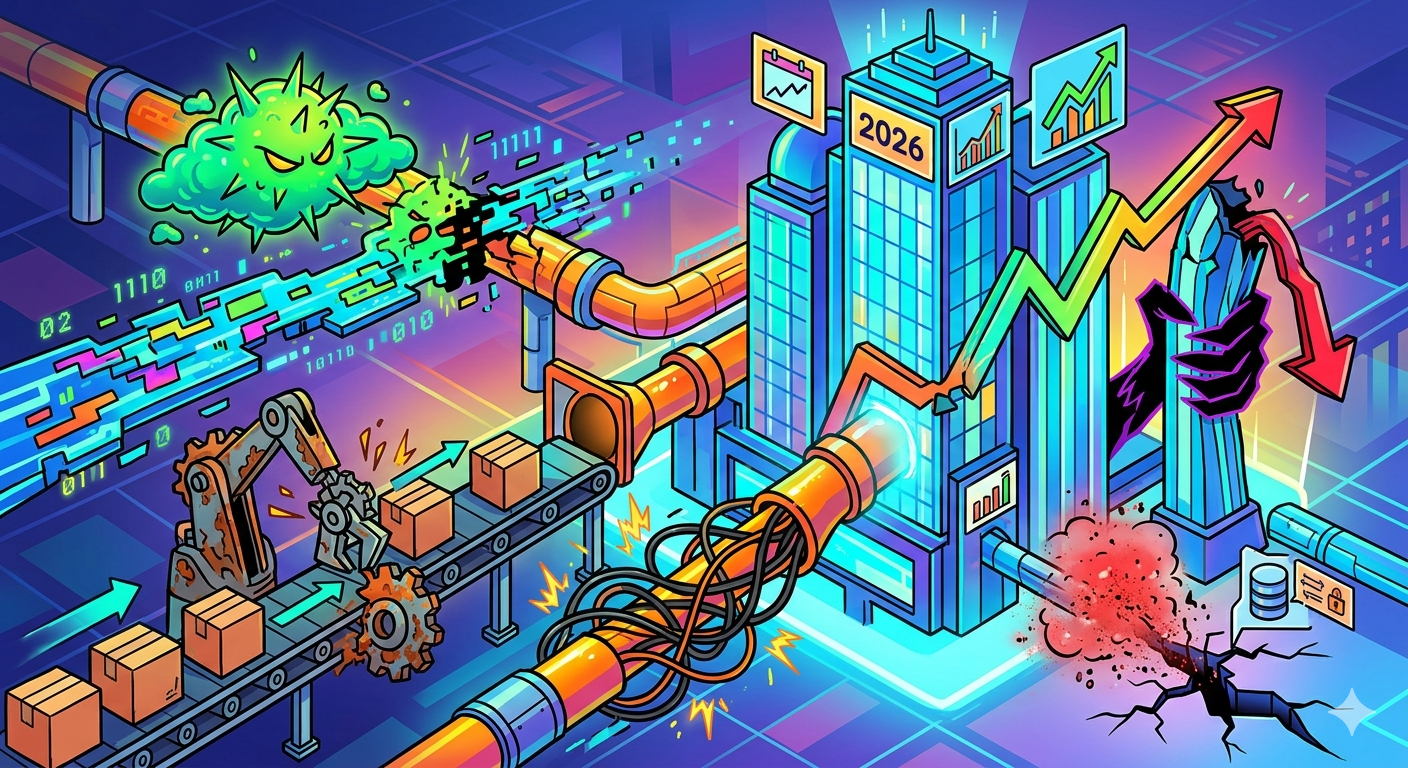
In the high-stakes environment of 2026, the traditional boundaries of a company no longer end at the office door or the edge of a private server. For growth-stage firms, the “company” is actually a sprawling, interconnected digital ecosystem. To scale at market speed, founders have outsourced everything: infrastructure to the cloud, payments to global gateways, and customer intelligence to specialized AI platforms.
But this efficiency hides a terrifying systemic vulnerability. Today, a company is only as resilient as its weakest vendor.
History is littered with “growth darlings” that did everything right—product-market fit, aggressive sales, stellar talent—only to be brought to their knees by a third-party failure they didn’t see coming. When a critical vendor suffers a breach or an outage, it creates a “cascading failure” that can freeze revenue and destroy institutional trust in a matter of hours.
Here are the five lethal third-party risks that demand a seat at the boardroom table this year.
1. The Concentration Crisis: When “Reliability” Becomes a Single Point of Failure
There is a dangerous comfort in the dominance of the “Big Three” cloud providers. In the rush to scale, most firms treat AWS, Azure, or GCP as infallible utilities—as fundamental and reliable as electricity. However, 2026 has proven that regional outages are no longer “if” scenarios; they are “when” scenarios.
Imagine a Tuesday morning during a peak sales quarter. A major subsea cable fault or a botched configuration at a Tier-1 provider ripples across the APAC region. Suddenly, the “reliable” infrastructure isn’t there. If a company’s production environment, identity management, and customer data are all housed within that single ecosystem, the business doesn’t just slow down—it ceases to exist.
The Strategic Reality: Many founders view “Multi-Cloud” as a luxury for the Fortune 500. This is a misunderstanding of risk. Strategic resilience isn’t about doubling the cloud bill; it’s about de-coupling critical functions. A business that cannot function when its primary provider has a bad day is a business built on a foundation of glass. True leadership requires an architectural redundancy that ensures a vendor’s regional outage doesn’t become a company’s terminal event.
2. Shadow SaaS: The “Authorized” Backdoor into Your IP
Innovation often moves faster than oversight. In the pursuit of a “Growth Milestone,” a marketing head might integrate a new AI analytics tool with a corporate credit card. An HR lead might connect a third-party “culture-tracking” app to the company’s internal Slack. On the surface, these are just productivity wins. Under the hood, they are data siphons.
These “micro-vendors” often operate with a “move fast and break things” mentality, which usually includes breaking standard security protocols. By granting these tools “Read/Write” access via a simple OAuth login, the company has effectively handed over the keys to its most sensitive intellectual property and customer data to a startup that may not even have a dedicated security team.
The Strategic Reality: It is impossible—and counterproductive—to ban external tools. But there is a massive difference between “enabling the team” and “blindly trusting the ecosystem.” The goal is a Strategic Vendor Onboarding Framework that vets for risk at the point of purchase. Without this, every new subscription is just another potential entry point for a threat actor who doesn’t need to hack the firewall because they’ve been “invited” in through the front door.
3. Regulatory Contagion: The Compliance Domino Effect
Expansion into markets like Singapore, the UAE, or Saudi Arabia requires more than just a sales team; it requires a deep understanding of sovereign data laws. In 2026, regulators have moved away from “educational grace periods” and into aggressive enforcement. The catch? You are legally responsible for where your vendors store your data.
If a third-party payment processor migrates its backup servers to a “gray-zone” jurisdiction to save on overhead, and that server contains data on your regional clients, your company is the one in violation of the law. The regulator won’t fine the vendor for your breach; they will fine you for failing to govern your supply chain.
The Strategic Reality: There are companies that lost their “License to Operate” in key markets because of a vendor’s backend server migration. This risk requires Active Regulatory Mapping. It means ensuring that vendor contracts aren’t just legal formalities, but ironclad agreements that protect the company’s ability to grow without being blindsided by a vendor’s compliance negligence.
4. “God-Mode” Legacy Access: The Ghost in the Machine
Fast-growing companies hire a lot of help: digital agencies, specialized consultants, and freelance developers. To do their jobs, these third parties are often given high-level access to the company’s GitHub, cloud consoles, or CRM.
The danger arises six months later when the project is over, but the access remains. In the cybersecurity world, these are known as “Zombie Accounts.” They sit dormant, forgotten by the IT team and the department head, until the agency suffers a breach. Suddenly, a threat actor has a permanent, authorized “God-mode” login to your production database. They don’t need to break in; they simply log in using credentials that were never revoked.
The Strategic Reality: This is the most preventable—yet most common—cause of catastrophic data loss. It is a housekeeping failure with executive-level consequences. Solving this requires Identity Governance. Treating every third-party connection as a temporary, “least-privileged” access point ensures that the “Ghost in the Machine” is exorcised the moment the contract ends.
5. The SLA Illusion: Why “99.9%” is a Financial Myth
There is a common executive misconception that Service Level Agreements (SLAs) are a form of insurance. “If the vendor goes down, we’re covered,” is a phrase that has preceded many corporate disasters.
The math rarely favors the customer. If a company loses $150,000 in revenue during a 24-hour vendor outage, a “standard” SLA might offer a 10% credit on that month’s $1,000 subscription fee. The company just traded a six-figure revenue loss for a $100 credit. An SLA is a legal contract regarding uptime; it is not a recovery plan for your business.
The Strategic Reality: SLAs are for the legal team; Recovery Time Objectives (RTO) are for the leadership team. Strategic resilience means knowing exactly how long the business can survive a vendor failure before the damage becomes irreversible. It’s about building a “failover” strategy that allows the company to keep moving when a partner falls, rather than waiting for a vendor’s support ticket to be resolved while the bottom line bleeds out.
Conclusion: From Tactical Security to Strategic Resilience
As 2026 progresses, the complexity of the global supply chain will only intensify. The era of viewing “security” as a technical checklist is over. In its place is the era of Strategic Operational Resilience.
The companies that will dominate their sectors are the ones that recognize they are part of an ecosystem—and actively manage that ecosystem’s risks. It is no longer enough to grow fast; you must grow securely. You must ensure that the vendors you rely on to scale are bridges to your next milestone, not trapdoors to a public-relations nightmare or a failed funding round.
The board doesn’t want to hear that a vendor failed. They want to hear how the company was prepared for it.